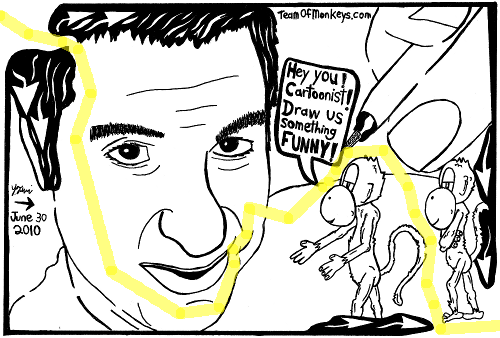
Self portrait maze cartoon of cartoonist Yonatan Frimer
Click here for a printable, hi-res version of this maze
Click here for the maze solution to self portrait of Yonatan Frimer
More maze cartoons by Yonatan Frimer at http://teamofmonkeys.com
Maze Cartoon of a Predator Drone as the border of US and Mexico
Maze cartoon of a predator drone in place as the border between the USA and Mexico. Created by Yonatan Frimer.
Click here for a printable, hi-res version of this maze
Click here for the maze solution to Border Reaper
Click here for Team Of Monkeys . com for Maze Cartoons
More about this maze cartoon's topic:
US to Deploy Predator Drones Along Texas-Mexico Border

Homeland Security chief Janet Napolitano has confirmed plans for the United States to deploy unmanned Predator drones to patrol the US-Mexico border in Texas. The United States currently has four drones patrolling the border with Mexico in Arizona and one in the northern border with Canada in the state of North Dakota. Napolitano made the announcement during a speech at the Center for Strategic and International Studies.
Janet Napolitano: "I’m also proud to announce today that the Federal Aviation Administration has approved the use of CBP unmanned aircraft system flights along the Texas border and in the Gulf region...These types of flights aren’t useful everywhere, but in some places they’re part of the right mix of infrastructure, manpower and technology that improves border security."
Homeland Security chief Janet Napolitano also unveiled new plans to increase government surveillance along the border by developing a system to begin photographing the license plates of every vehicle.
Janet Napolitano: "We’re partnering with the Office of National Drug Control Policy to implement Project Roadrunner, an automated license-plate recognition system. Project Roadrunner was conceived to target both north- and southbound drug trafficking and associated illegal activity along the Southwest border."
Maze cartoon of a motorcycle lableled, "middle east" speeding down a road in the direction of war, and away from the direction of peace. Created by Yonatan Frimer
Click here for a printable, hi-res version of this maze
Click here for the maze solution to Motorcycle maze.
click here to view the latest maze cartoons by Yonatan Frimer
Click here to view maze art by Yonatan Frimer
More about this maze cartoon's topic:
Turkey’s provocative flotilla—often described in Orwellian terms as a humanitarian mission—has set in motion a flurry of diplomatic activity, but if the Iranians send escort vessels for the next round of Turkish ships, it could present a casus belli.
It is also instructive that Syria is playing a dangerous game with both missile deployment and rearming Hezbollah. According to most public accounts, Hezbollah is sitting on 40,000 long-, medium- and short-range missiles and Syrian territory has served as a conduit for military material from Iran since the end of the 2006 Lebanon War.
Should Syria move its own scuds to (Click here to read the full article)

Israel could see what was coming. Before the convoy set sail, Israeli leaders pleaded with Turkish officials to stop it; they offered to allow the supplies to be delivered through an Israeli checkpoint. But Erdoğan’s government let it go anyway. Thus, Israel had no choice but to intervene directly. And those on the boat made sure it turned violent.
Now, Turkey is milking the event for all it’s worth. It accused Israel of state-sponsored terrorism. It compared the psychological impact of the incident on Turks to the 9/11 terrorist attacks on Americans. Turkish President Abdullah Gül called the Israeli raid a crime against humanity and said Israeli-Turkish relations will never be the same. Erdoğan labeled it a massacre. Turkish armed forces announced several cutbacks in cooperation with Israeli forces. The government also offered to supply Turkish naval protection for the next “aid” convoy to Gaza; “This would be, in effect, an act of war,” wrote Mark Steyn, “—more to the point, an act of war by a nato member against the State of Israel.”
(Read the full article on The Trumpet)
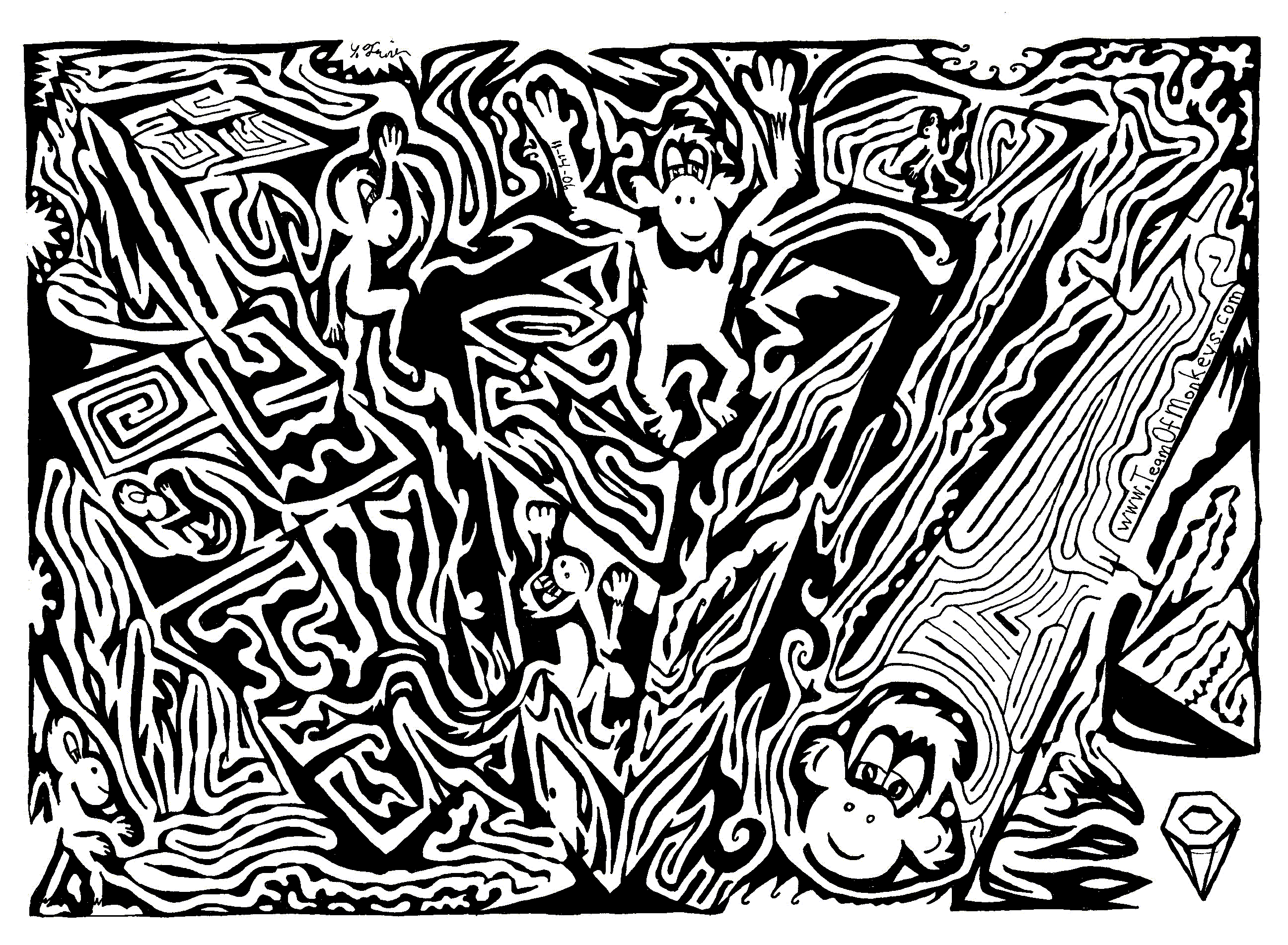
NEW YORK, June 17 (Reuters) - Around the turn of every year, bankers can think of only one thing: the size of their bonuses.
Even beyond bonus season, they run different scenarios and assumptions, trying to calculate their number.
This distracts them so much that the bigger the bonus at stake, the worse the performance, according to behavioral economist Dan Ariely, who lays out his theory in his new book "The Upside of Irrationality" (HarperCollins, $27.99).
"For a long time we trained bankers to think they are the masters of the universe, have unique skills and deserve to be paid these amounts," said Ariely, who also wrote the New York Times bestseller "Predictably Irrational."
"It is going to be hard to convince them that they don't really have unique skills and that the amount they've been paid for the past years is too much."
Ariely's findings come as regulators try to rein in Wall Street's bonus culture after the 2008 financial collapse. The financial industry argues it needs to pay large bonuses to attract and motivate its top employees.
In an experiment in India, Ariely measured the impact of different bonuses on how participants did in a number of tasks that required creativity, concentration and problem-solving.
One of the tasks was Labyrinth, where the participants had to move a small steel ball through a maze avoiding holes. Ariely describes a man he identified as Anoopum, who stood to win the biggest bonus, staring at the steel ball as if it were prey.
"This is very, very important," Anoopum mumbled to himself. "I must succeed." But under the gun, Anoopum's hands trembled uncontrollably, and he failed time after time.
A large bonus was equal to five months of their regular pay, a medium-sized bonus was equivalent to about two weeks pay and a small bonus was a day's pay.
There was little difference in the performance of those receiving the small and medium-sized bonuses, while recipients of large bonuses performed worst.
SHOCK TREATMENT
More than a century ago, an experiment with rats in a maze rigged with electric shocks came to a similar conclusion. Every day, the rats had to learn how to navigate a new maze safely.
When the electric shocks were low, the rats had little incentive to avoid them. At medium intensity they learned their environment more quickly.
But when the shock intensity was very high, it seemed the rats could not focus on anything other than the fear of the shock.
This may provide lessons for regulators who want to change Wall Street's bonus culture, Ariely said. Paying no bonus or smaller bonuses could help fix skewed incentives without loss of talent.
"The reality is, a lot of places are able to attract great quality people without paying them what bankers are paid," Ariely said. "Do you think bankers are inherently smarter than other people? I don't." (Reporting by Kristina Cooke; Editing by Daniel Trotta)


This feeling is a common (and, yes, somewhat scary) experience that a group of neuroscientists think they can better explain. In an experiment with rats, researchers at MIT identified two distinct neural circuits in the brain that show distinct changes when the rats were learning to navigate a maze and, later, after they mastered the task.
The rats were placed in a maze that had chocolate sprinkles at the end. The activity in specific parts of their brains was analyzed as they learned the maze, which included a T-juncture where they had to stop and choose to turn right or left. The rats performed the maze repeatedly until they had learned it.
The study showed that one specific neural circuit became stronger with practice. A second neural circuit showed high activity occurring at times when the rats had to make a decision in the maze. But as they learned the maze, activity in this circuit declined. The task had become habitual.
So, arriving at school in one piece wasn't just a matter of luck. "It is good to know that we can train our brains to develop good habits and avoid bad ones," the lead author of the study, Ann Graybiel, said in a news release.
Understanding how specific regions of the brain change through learning could help in developing new treatments for brain-based diseases. The study was published Thursday in the journal Neuron.
-- Shari Roan
Photo credit: Advanced Cell Technology Inc.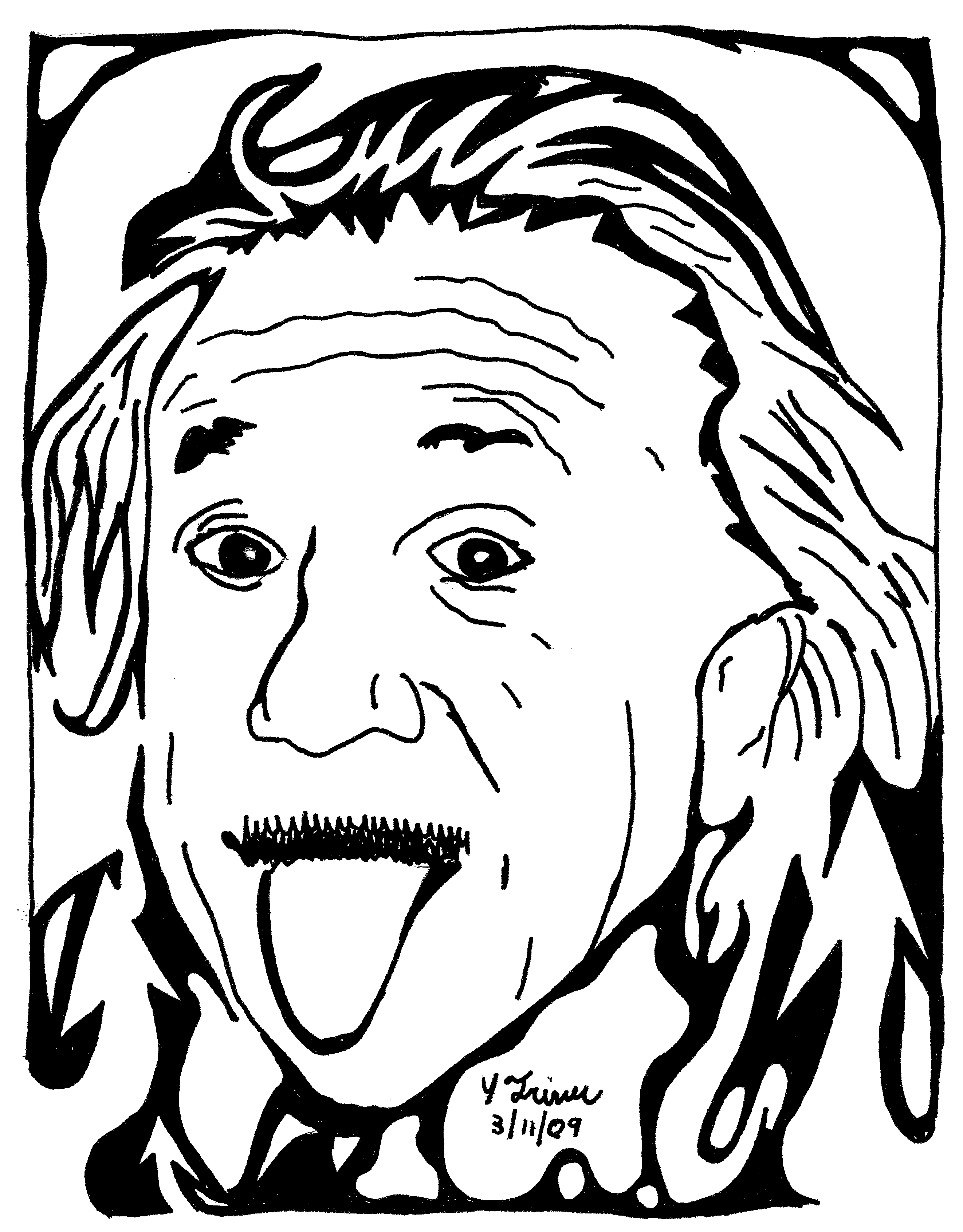


UNITED NATIONS -- After several months of grueling diplomacy, the U.N. Security Council on Wednesday imposed a fourth round of sanctions on Iran's military establishment -- a move that the United States and other major powers said should prompt the Islamic Republic to restart stalled political talks over the future of its nuclear program.
Secretary of State Hillary Rodham Clinton and the foreign ministers of allied nations asked the European Union's chief diplomat to pursue talks with Iran at the "earliest possible opportunity," and President Obama asserted that "these sanctions do not close the door on diplomacy."
"We think that the sanctions send a kind of message to the entire Iranian leadership, which.... (Read Source Article)


I am appalled that Helen Thomas's comments on Israel prevent her from speaking at Walt Whitman High School's commencement ["Helen Thomas bows out of speech," Metro, June 7]. I am also disgusted that Ari Fleischer and Lanny Davis conducted a campaign to punish Ms. Thomas, no doubt as retribution for her outspoken questions when they served in earlier administrations. Freedom of speech, however, is lost to their petty maneuvering.
Most of us would not agree with Ms. Thomas's unfortunate and seemingly uninformed comments about where Jews might live in peace. But she has the right to say what she thinks, and listeners can decide whether she is foolish, biased and out of touch. Had she spoken at Whitman, perhaps she would have retracted, perhaps she would have lamented further . . . or maybe not.
Whitman's cancellation under...Read entire article


Denial of the Armenian Genocide is the assertion that the Armenian Genocide did not occur in the manner or to the extent described by scholarship. The Armenian Genocide is widely acknowledged by genocide scholars to have been one of the first modern, systematic genocides, as many Western sources point to the sheer scale of the death toll as evidence for a systematic, organized plan to eliminate the Armenians.
The Republic of Turkey, as well as modern Azerbaijan and several other states do not officially recognize the Armenian Genocide. After a long period of complete denial...(Read full article)